


Thermal river water use for heat transition
Advantages of river heat:
Rivers provide relatively mild temperatures in winter, which can be put to good technical use in heating systems. In conjunction with heating networks, this opens up new options for decentralised, fossil-free heating and cooling – not only in large cities, but also in smaller communities.

Closed river water heat pumps: Heat exchangers installed directly in the river as a sustainable solution
Here, heat transfer takes place directly in the river via a heat exchanger installed in the water. The river water does not come into direct contact with the heat pump, which means that there is no chemical contamination. Examples include the ComPons from our partner JNinfra or smaller river heat exchangers such as the ThermoGenius from ElringKlingerKunststofftechnik. Submerged heat exchangers are particularly useful when the flow is strong enough to ensure efficient heat exchange. They do not cause water displacement and usually do not require complex construction measures.

Open systems: River water extraction and return
In an open system, river water is taken from a water intake structure, treated and passed through a heat exchanger (usually in an energy centre). It is then returned via a discharge structure with only minimal thermal changes. This thermal discharge can have an impact on the ecosystem, for example through temperature changes or the displacement of nutrients if the intake and discharge points are far apart. The effects are usually local, but can also be felt over several kilometres depending on the temperature and quantity. Careful planning is therefore essential. The choice of system depends on the site conditions and specific requirements. Economic aspects are not considered in this article, as they are highly project-dependent.
| Closed System | Open System | |
| Advantages | Direct heat transfer: The heat exchanger is installed directly in the river, allowing the natural flow to continuously renew the heat source. | Easy maintenance: All system components are accessible from land, which facilitates cleaning and maintenance. |
| Low maintenance: Fewer moving parts and no pumps required for water transport. | More efficient heat exchangers: Higher flow rates achieved by pumps enable better heat transfer. | |
| No additional pump power required | Continuity: Water treatment ensures consistent water quality, even when suspended solids concentrations fluctuate. | |
| No intermediate circuit required: With suitable protective mechanisms, an intermediate circuit is not necessary, which reduces energy losses. | ||
| Disadvantages | Protective measures required: Floating debris, fish, shipping and fluctuating water levels must be taken into account. | Complex water treatment: Suspended solids and biofouling require multi-stage cleaning systems, which increases costs. |
| Danger in the event of leaks: (minimal) water contamination due to water-glycol mixture in the heat exchanger. | Pumps required: Additional energy for water transport and higher operating costs. |
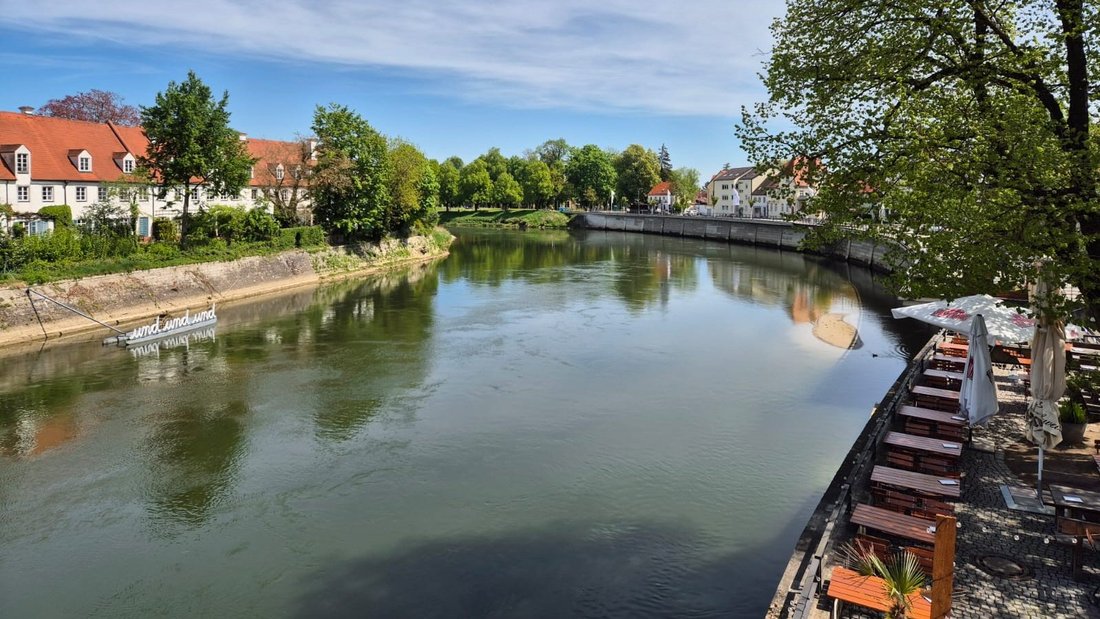
The Danube as an energy source: Practical analysis of river water heat pumps in Bavaria
In his bachelor's thesis at the Institute for New E-Systems (INES) at the Technical University of Ingolstadt, our working student Valentin Pröpster took an in-depth look at the topic of river water heat. The following findings are taken from his thesis entitled ‘Influencing factors for the techno-economically viable operation of a river water heat pump to supply a district with renewable heat (...)’.
Comparison of renewable sources with a focus on river water
River water is a promising heat source for heat pumps because it is continuously renewed and has excellent thermal properties. Compared to air and soil, river water offers high specific heat capacity and lower temperature fluctuations, which increases the efficiency of heat pumps.
- Continuous renewal: River water is constantly renewed and offers excellent thermal properties.
- High specific heat capacity: River water:4.18 kJ/kg·K, air: 1.01 kJ/kg·K.
- Low temperature fluctuations: River water has a flatter temperature amplitude over the course of the day and year, which increases the efficiency of heat pumps.
- More efficient heat exchangers: Water-water plate heat exchangers achieve 1000–8000 W/(m²·K), air-water plate heat exchangers only 10–150 W/(m²·K).
- Further advantages: Smaller heat exchangers, no need for fans, lower noise levels.
Specific challenges when using river water as a heat source
- Suspended solids: Can cause deposits and blockages.
- Biofouling: Can reduce the heat transfer coefficient by up to 50%.
- Icing: Particularly critical at temperatures around 0 °C; minimum flow water temperature of approx. 3-5 °C required.
Practical examples of challenges faced by early systems: In Jena, a system had to be retrofitted due to icing; in Cologne, algae deposits led to a 40% loss in efficiency, which was remedied by automatic cleaning systems (source: www.efzn.de/forschung/efzn-foerderung/projekt-hydro2heat).
Legal framework for river water heat pumps: What operators need to consider
The use of river water is subject to strict legal regulations designed to protect water bodies and ensure the quality of the water extracted.
- European Water Framework Directive (EU WFD): Prohibition of deterioration in water quality.
- Water Resources Act (WHG): Permit requirement for the extraction of surface water.
- Temperature limits: No binding maximum value, but a guideline value of two Kelvin for temperature increases.
- Further regulations: Geothermal Energy Act (GeoWG), guidelines of the State Working Group on Water (LAWA).
- In January 2025, the Bavarian State Office for the Environment published the information sheet ‘Heat generation from flowing waters - Operator guidelines for the planning, approval and operation of heat exchanger systems’. (https://www.lfu.bayern.de/publikationen/get_pdf.htm?art_nr=lfu_was_00364)
- However, Bavarian Minister of State Thorsten Glauber promised at the 7th Bavarian Geothermal Forum in early May at the Munich Building Centre to support the use of water for heat generation.
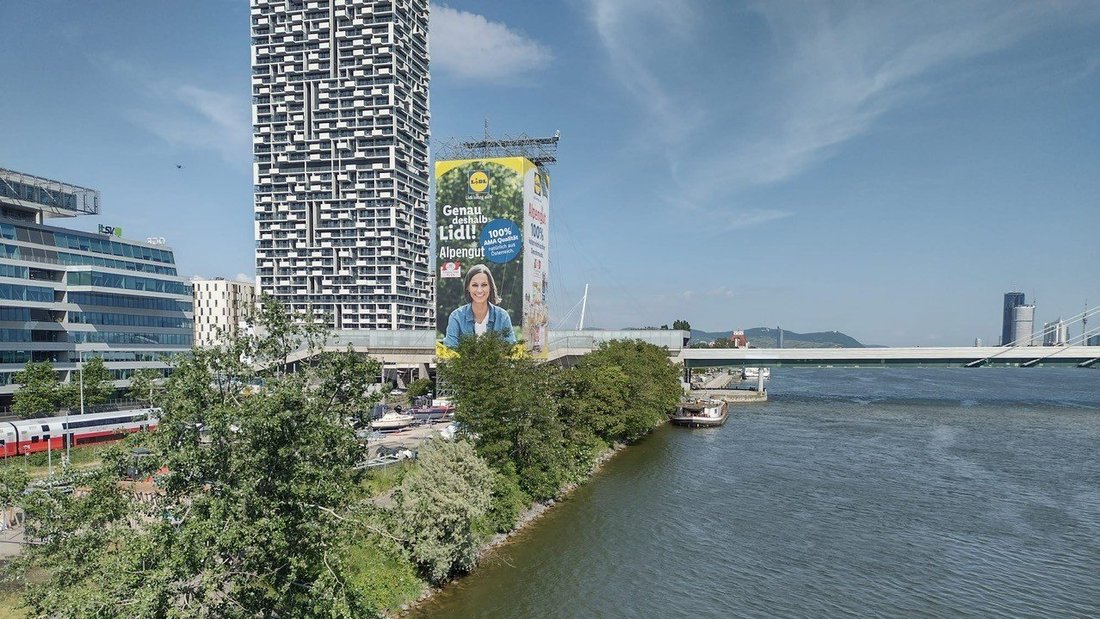
Potential of the Danube as a source of heating and cooling:
The Danube offers sufficient thermal potential for heat supply: every year, the Danube carries around 9 billion cubic metres of water, which, in purely mathematical terms, corresponds to a gross potential of 10.4 TWh of thermal energy per year if 1 Kelvin of thermal energy were extracted.
The heat demand of all households in Neuburg is 240,000 MWh per year. This could therefore theoretically be covered more than 40 times over. The concentration of suspended solids in the Danube is low compared to other Bavarian rivers and does not pose any restrictions for river water heat pumps.
goodmen energy is currently planning several river water utilisation projects on the Danube to exploit this potential.
Possible ecological impacts of thermal river water use on aquatic habitats
The thermal use of rivers and lakes can have ecological impacts on aquatic habitats. Temperature changes caused by the discharge of heated or cooled water affect the living conditions of numerous organisms: water that is too warm – especially above 25 °C – can be stressful or even life-threatening for temperature-sensitive species such as trout or grayling. Until now, water bodies have tended to be used for cooling, which has warmed them in addition to the effects of climate change. Since 1980, rivers in Bavaria have been warming by 0.5 K every 10 years.
This effect can be mitigated or even reversed by extracting heat for heating networks. Our working student's bachelor thesis also shows that the thermal effects in the Danube would be minimal: even during peak heating loads on the coldest days in winter, the calculated cooling of the total water body would only be 0.0013 K. The annual average would be only 0.00049 K. These values do not indicate any ecological impact, but could even have positive effects on water quality because they would slow down or compensate for increasing warming.
Conclusion: With proper planning and consideration of sensitive temperature ranges, the ecological impact can be greatly limited.
Side note: LAWA guidelines for the thermal use of flowing waters: temperature limits, fish protection and permits
The Inter-State Working Group on Water (LAWA) sets strict conditions for the thermal use of flowing waters:
- Temperature change: Maximum warming of 2–3°C, 1.5°C in sensitive sections; similar values recommended for cooling.
- Cumulative assessment: Multiple discharges are considered in aggregate.
- Fish protection: Avoid sudden temperature changes.
- Minimum water flow: Only ecologically compatible water extraction.
- Technical requirements: Fish protection, approved heat transfer media, permit requirement.
Our conclusion: Thermal river water utilisation as the key to a sustainable and efficient heat transition
Sustainable river water use should consider heating and cooling simultaneously in order to balance thermal changes. Combining it with other technologies, such as solar thermal energy and seasonal storage, increases efficiency. The thermal use of river water is technically feasible, ecologically responsible and economically viable – provided the framework conditions are right. In order to leverage the potential for the heat transition, approval procedures should be simplified and standardised.
Are you planning a river water utilisation project or would you like to learn more about the possibilities of aquathermal energy? Contact us – we will be happy to advise you!